The Silver Lining: Decoding Levi's "Bat Wing" Care Labels (1994-2007)
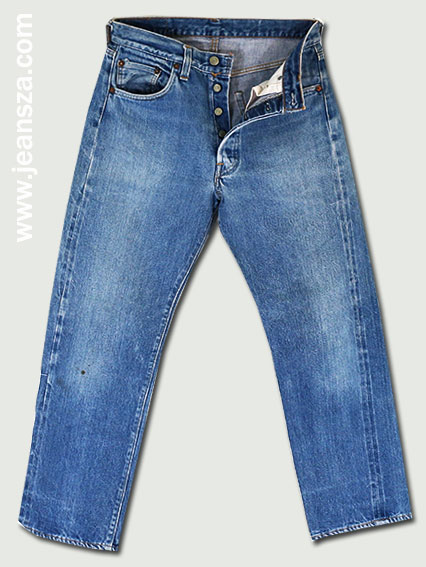
Let's revisit the Levi's care label, a detail every enthusiast knows well. This article focuses on the "Bat Wing" care labels from the 1994-2007 era. During this time, Levi's 501 jeans reached peak fame, becoming a fashion staple and a target for counterfeiters, especially in Asia.
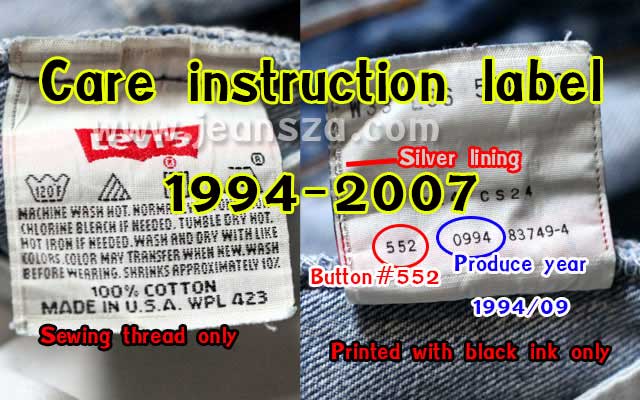
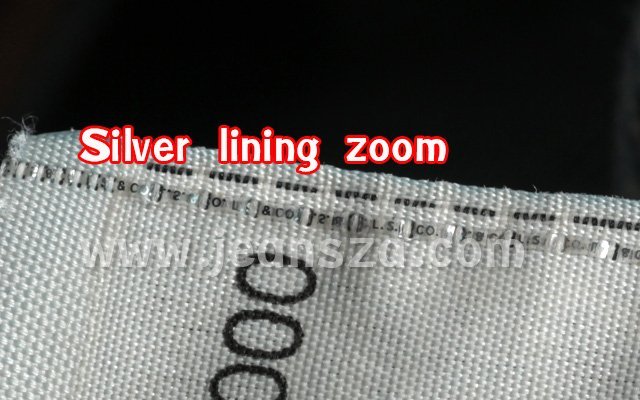
To combat this, Levi's introduced a new care label design in 1994 with an important anti-counterfeiting feature: a silver ribbon or silver lining along the edge. Many collectors refer to this new design as the "Silver Bar," "Silver Tag," or "Silver Lining" label. If you held these jeans up to the light, the ribbon would shine brightly, a clear sign of authenticity.
Decoding a 1994 "Bat Wing" Label
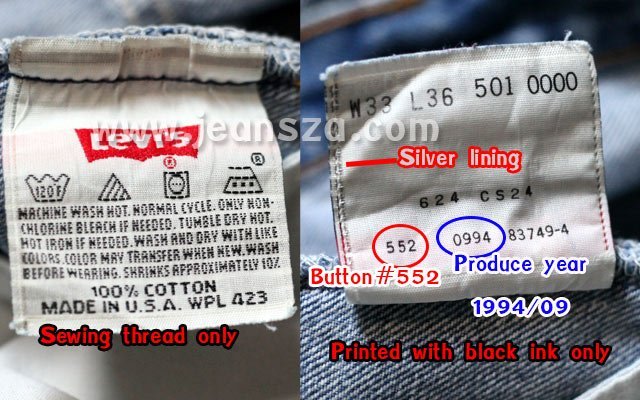
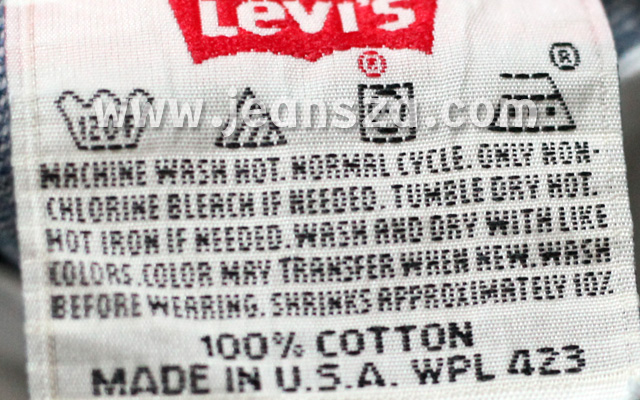
The first iteration of this new label appeared in 1994. On the left side of the label, you'll see a clear, red "Bat Wing" logo with all the text embroidered in black.
-
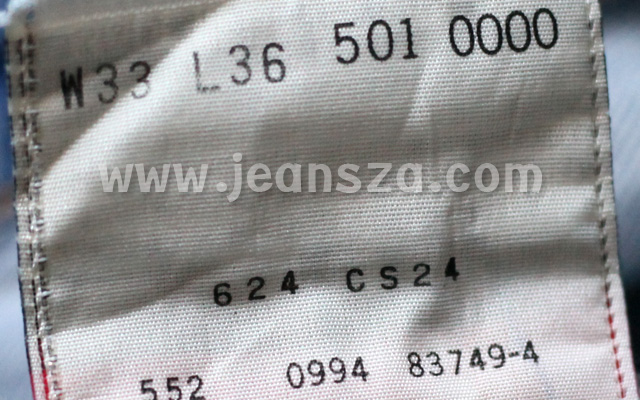
On the back of the tag: The alphanumeric code on the other side of the label provides key production details. For example, a code of 552 is the factory location code for a U.S. production facility. This number must match the number stamped on the back of the top button for authentication.
-
Production Date: The four-digit number 0904 tells us the exact production date. The first two digits (09) represent the month (September), and the last two digits (04) represent the year (1994).
Evolution of the "Silver Lining" Label
The "Silver Lining" label design continued to evolve over the years.
-
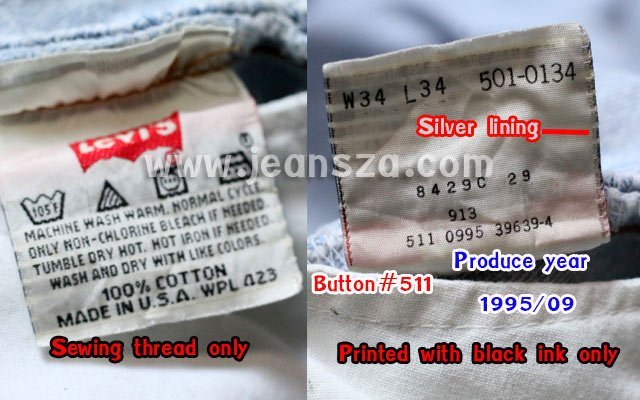
1995: The only significant change in 1995 was the relocation of the silver ribbon to the right side of the label. An example from this year shows a production date of September 1995 and a button number of 511.
-
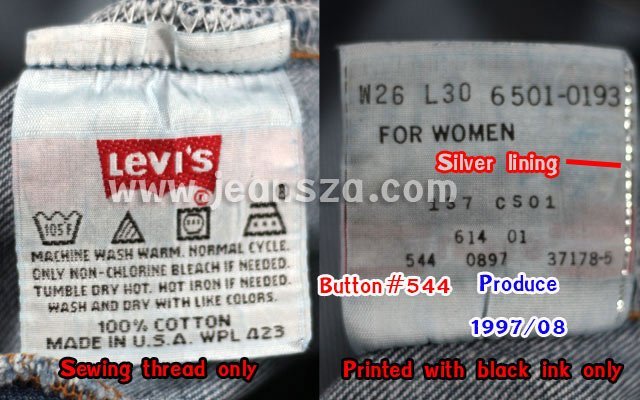
1997: Labels for women's jeans, such as the Levi's 6501-0193, began to include the text "for women." Men's jeans did not have this text. An example from this year has a production date of August 1997 and a button number of 544.
-
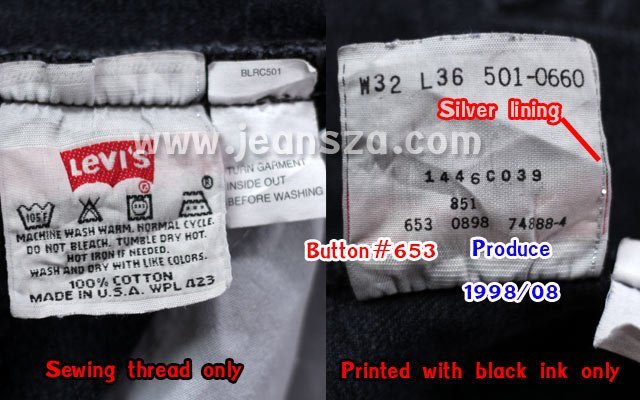
1998: The design remained consistent, with an example for the 501-0660 Super Black model showing a production date of August 1998 and a button number of 653.
-
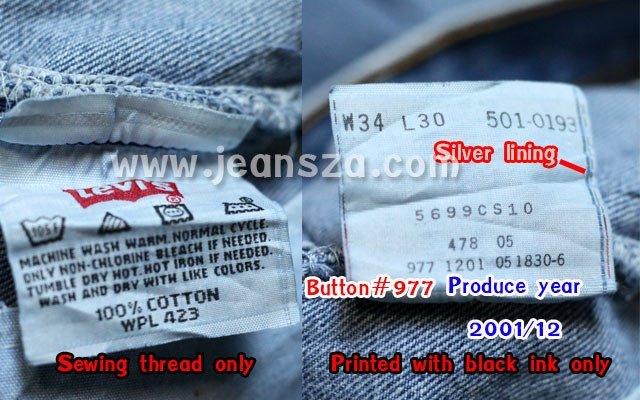
2001: The style was still maintained, as seen on a 501-0193 model produced in December 2001 with a button number of 977.
The Final Years and Key Authentication Points
The "Silver Lining" label continued to be used as production began to shift from the U.S. to other countries.
-
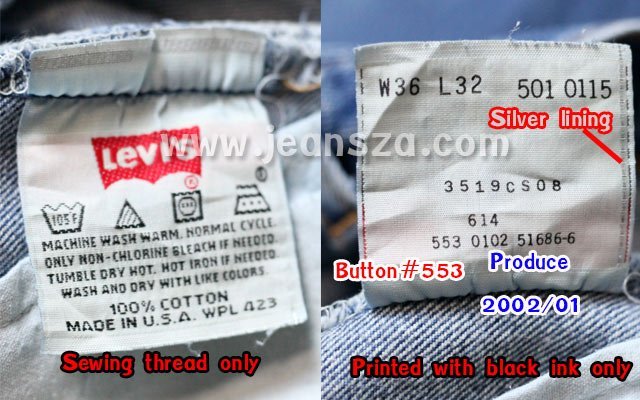
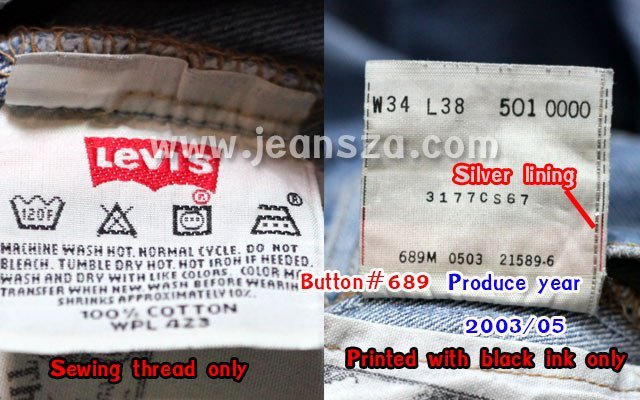
2002-2003: An example of a 501-0115 model from January 2002 shows a button number of 553, still Made in USA. A 501-0000 STF model from May 2003 with a button number of 689 represents one of the final U.S. productions.
-
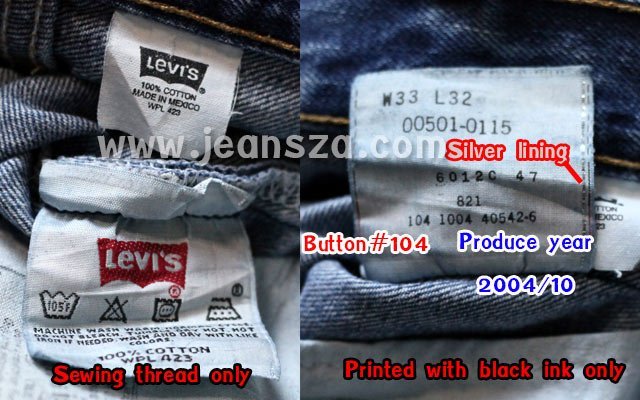
2004: A care label for a 501-0115 from October 2004 with a button number of 104 shows a shift to Made in Mexico.
-
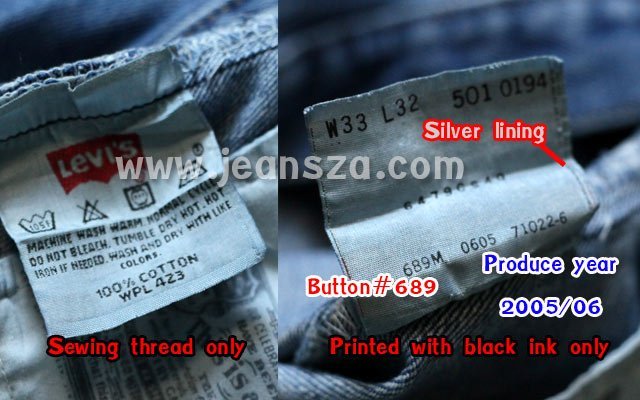
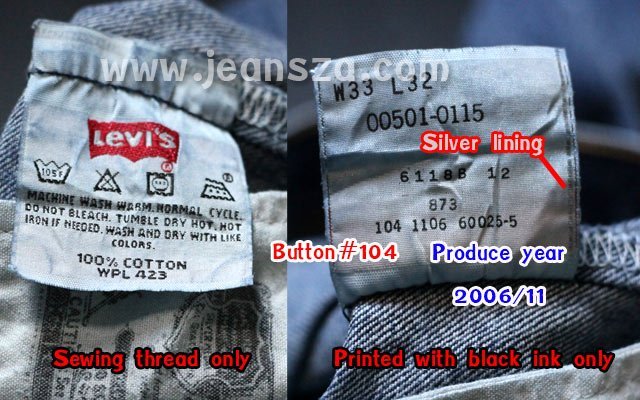
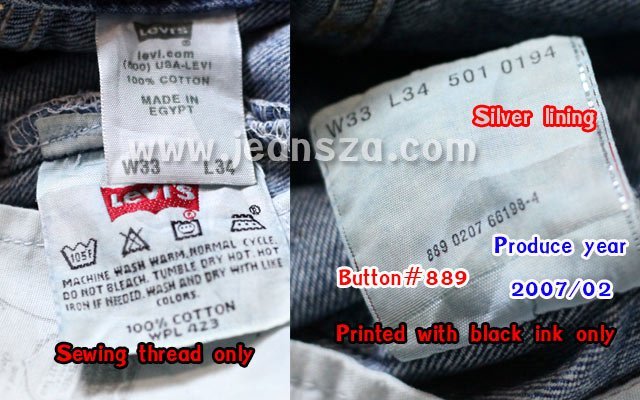
2005-2007: The style persisted on models like the 501-0194 from June 2005 (button 689), 501-0115 from September 2006 (button 104), and 501-0194 from February 2007 (button 889).
When authenticating a "Silver Lining" label, you must consider the following:
-
Embroidery vs. Print: On the side with the "Bat Wing" logo, both the logo and the numbers should be embroidered.
-
The Silver Ribbon: The silver ribbon is a critical feature. Fake labels often lack this metallic luster.
-
Text on the Back: On the reverse side of the label, the letters and numbers should be printed with black ink, not embroidered. A common mistake on counterfeit labels is to embroider the text on both sides.
By paying attention to these details, you can confidently identify and authenticate genuine vintage Levi's from this important era.